ASTM A453 Grade 660 Class B (660B) is solution treated at 1800 ± 25 °F [980 ± 14 °C] for 1 h min and liquid quenched, then aged at 1325 ± 25 °F [720 ± 14 °C] for 16 h and air cooled (A453/A453M-17 Table 4). Table 5 requires 130 ksi [895 MPa] tensile, 85 ksi [585 MPa] yield (0.2 % offset), 15 % elongation, 18 % reduction of area and 248 to 341 HB (24 to 37 HRC). Stress-rupture testing applies when the design temperature is above 800 °F [427 °C]: 1200 °F [650 °C] at 56 ksi [385 MPa], 100 h minimum to rupture, 5 % minimum elongation (8.2.1, Table 6). Bolting that is not stress-rupture tested is permanently stamped NR. Class B differs from Class A only in the solution treatment, 1800 °F [980 °C] for 1 h instead of 1650 °F [900 °C] for 2 h; the ageing, tensile, hardness and stress-rupture requirements are the same (Tables 4 to 6). The 1800 °F [980 °C] solution treatment matches ASTM A638 Grade 660 Type 2; A453 Grade 660 Class B is the same alloy as EN 10269 1.4980 (X6NiCrTiMoVB25-15-2), but EN 10269 sets its own property limits, so it is not a class-for-class substitute. For sour service, ISO 15156-3 (NACE MR0175) limits UNS S66286 to 35 HRC, so Class B hardness has to be held below its 37 HRC maximum. ASTM A453 Grade 660 Class B bars, wire rod, forgings and fasteners are supplied by TorqBolt.
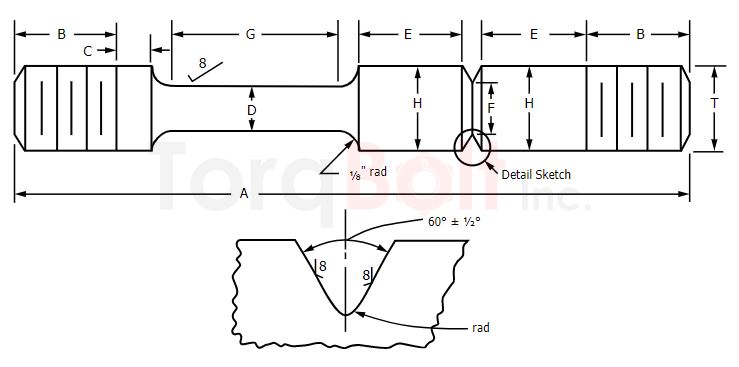
(A) The combination bar specimen shown in Fig. 1 shall be tested continuously at the temperature and at the minimum stress specified or at a greater stress and shall rupture in a time not less than that specified.
(A) When it is necessary to heat treat or heat treat and pickle after cold finishing, because of special hardness or mechanical property requirements, the permissible variations are generally double those shown in the table.
(B) For size tolerances of sizes over 4 in. [100 mm], the manufacturer should be consulted.
Chloride Stress Corrosion Cracking
The operational limits of ASTM A453 GRADE 660B with 128 ksi actual yield strength (36 HRC) were determined by series of corrosion and environmentally-assisted cracking tests in various fluids. ASTM corrosion test coupons were subjected to 30-days immersion in aerated artificial seawater to evaluate pitting and crevice corrosion. Sets of triplicate C-rings per NACE standard TM0177 were machined for testing in both the H2S NACE limits of superduplex stainless steels and 11.6ppg CaCl2 brine. The tests revealed that A453 Grade 660 class B was severely restricted due to chloride stress-corrosion cracking though the alloy was found to survive 3psi H2S, 120,000ppm Cl- up to 300°F. The alloy repeatedly failed in the CaCl2 brine at a temperature as low as 200°F. Comparing these results with those of AF935, high-strength alloys for production environments appear to be well restricted to alloys with at least to 30 to 35 wt.% nickel and 2 to 3 wt.% molybdenum. Despite environmental limitations, ASTM A453 Grade 660 Class B may be considered for service equipment as well permanent equipment in some dry gas or deaerated water injectors. Seawater immersion tests indicate that A453 Grade 660 Class B outperforms 17-4PH, an alloy sometimes used in injectors.
Heat Treatment
Annealing & Ageing Cycles
Grade Symbol
Class
Solution Treatment
Hardening Treatment
ASTM A453/A453M Grade 660
B
1800 ± 25 °F [980 ± 14 °C], hold 1 h, min, and liquid quench
1325 ± 25 °F [720 ± 14 °C], hold 16 h, air cool
(A) Times refer to the minimum time material is required to be at temperature.